Do You Install Generator Pads for Homes and Businesses?
Yes, we build pads for home standby generators and for larger units at stores, offices, churches, farms, and apartment buildings. Tell us the generator make and kW size.
Generator Pad Installation Kings provides generator pad installation, poured concrete generator slabs, and precast and gravel generator bases in the South Burlington, VT area for both residential and commercial properties, from home standby units to large liquid-cooled generators. Contact us now for a free estimate.
Generator pad installation in South Burlington, VT costs anywhere from $420 to $1,270 on average for one air-cooled home standby generator, from a precast pad on compacted stone to a small poured slab. The price depends on precast or poured, the pad's size and thickness, digging and base stone, rebar, slope and access, and whether an old pad has to come out first.
Yes, we build pads for home standby generators and for larger units at stores, offices, churches, farms, and apartment buildings. Tell us the generator make and kW size.
Yes, we cover the South Burlington, VT area. Send us the property address and we'll confirm.
Yes, we do. Potash, Bartlett, Centennial, Englesby and Munroe Brooks are South Burlington's stormwater-impaired watersheds, and the city spends money every year on stormwater work, including erosion and sediment control. We keep dug soil covered or bagged, rinse tools away from drains and leave no loose concrete where rain could carry it toward a brook.
Yes, we build pads for all the common home standby brands. Each maker lists its own pad size, thickness, and clearances, so send us the model number and we'll follow its manual.
We can usually schedule it as soon as any permit is approved and 811 has marked the buried utilities, which typically takes a few business days. Tell us your generator install date so we plan around it.
Yes, and that's the usual order, since a poured pad needs time to cure. Send us the model number so we size the pad to that unit.
Yes, we coordinate the pad size and timing with whoever sets the generator.
We need the address, the generator make, model, and kW, and photos of the spot beside the house. Mark where the gas meter and electric panel are, and mention any slope, downspouts, or shrubs nearby.
No, not once the location is agreed. It helps to be there when we mark the spot, because moving a slab after it's poured means breaking it out.
Yes, in many towns. Some permit the pad on its own, others fold it into the generator permit, and pad permits usually run $50 to $200. Your local building department decides, and we can tell you what's commonly required.
Yes, if your HOA reviews exterior equipment. Many want a site plan showing the generator location and screening, so get approval before we pour.
Yes, we confirm the price before starting. If we hit rock, roots, or an old buried slab once we dig, we talk to you before doing extra work.
We usually set a precast pad on a stone base in a few hours. A poured pad takes most of a day to dig, form, and pour.
The same day for a precast pad. A poured pad needs several days to cure first, and we'll tell your installer when it's ready.
Most home units must sit at least 5 feet from windows, doors, and vents. Fire-tested units can go as close as 18 inches to a wall, but many local codes ask for more, so we follow the manual and your local rules.
Usually beside the house near the gas meter and electric panel, since shorter runs cut trenching and wiring cost. We also keep it away from bedrooms, downspouts, and sump discharge.
No, not under a deck. Most units need about 5 feet of clear space above the enclosure, so eaves, balconies, and overhangs often decide where the pad can go.
Yes, in most cases, as long as it meets the local setback, often 3 to 5 feet. We measure from the pad's edges, not just the generator, and many towns don't allow generators in a front yard.
Yes, if the pad can meet the clearances to the house, windows, and property line. Measure the gap between the house and the fence or lot line and send us a photo.
Yes, most air-cooled home units are approved for a compacted pea gravel or crushed stone bed. Some towns require concrete, and gravel can settle over time, so we check your code first.
A precast pad is quicker and usually cheaper, and it suits most air-cooled home units. We pour on site for heavy liquid-cooled units or where local code requires a poured slab.
No, not when the topsoil is dug out and the stone base is compacted. Pads set on loose fill or soft soil can settle and tilt, so tell us if the spot was recently backfilled.
Yes, the built-in composite base still needs a level, compacted stone bed or a concrete pad under it. It isn't meant to sit on bare grass or soft soil.
Yes, we set customer-supplied precast and composite pads. A typical home pad is about 54 by 31 inches and weighs around 190 pounds, so tell us where it will be dropped off.
Precast home pads are usually 3 to 4 inches thick. Generac calls for about 5 inches on a poured pad, and heavier units or local codes can require more.
We make it at least 3 inches larger than the generator on every side, as Generac asks, and some makers want more. For a typical air-cooled home unit that's roughly 54 by 31 inches.
Yes, larger liquid-cooled units need a bigger, thicker pad, sometimes with rebar. Tell us the kW, the unit's weight, and whether a concrete truck can reach the spot.
Yes, we can build a raised concrete pedestal so the generator sits above expected flood water. In flood zones, many towns want the unit above the Base Flood Elevation.
Yes, in heavy snow areas we can raise the pad so the unit sits above the usual snow line. Tell us how deep snow typically drifts against that side of the house.
Yes, we can pour or set a thicker pad with anchor points so the unit can be bolted down where local code requires it. Ask your dealer whether your model has a hurricane pad option.
Yes, we cut into the slope or build up the low side so the pad sits level, and we shape the ground so water drains away.
Yes, the generator has to be lifted off first, usually by your dealer or electrician. Then we break out the old pad, firm up the base, and set or pour a new one.
Yes, we break out and haul away the old pad and build one sized for the new unit.
No, we request the 811 locate before digging. It marks public gas, electric, and cable lines but not private ones like sprinklers or landscape lighting, so point those out.
Yes, if it's easy. Move hoses, pots, and decor, and trim shrubs back, since the front and ends of the unit need about 3 feet of open space.
Yes, a precast pad can go in most of the year. Poured pads need ground that isn't frozen, and cold weather slows the cure.
We strip the sod and topsoil, then lay and compact 3 to 5 inches of crushed stone so the pad drains and stays put. Poured pads are formed with wood and sit on the same kind of base.
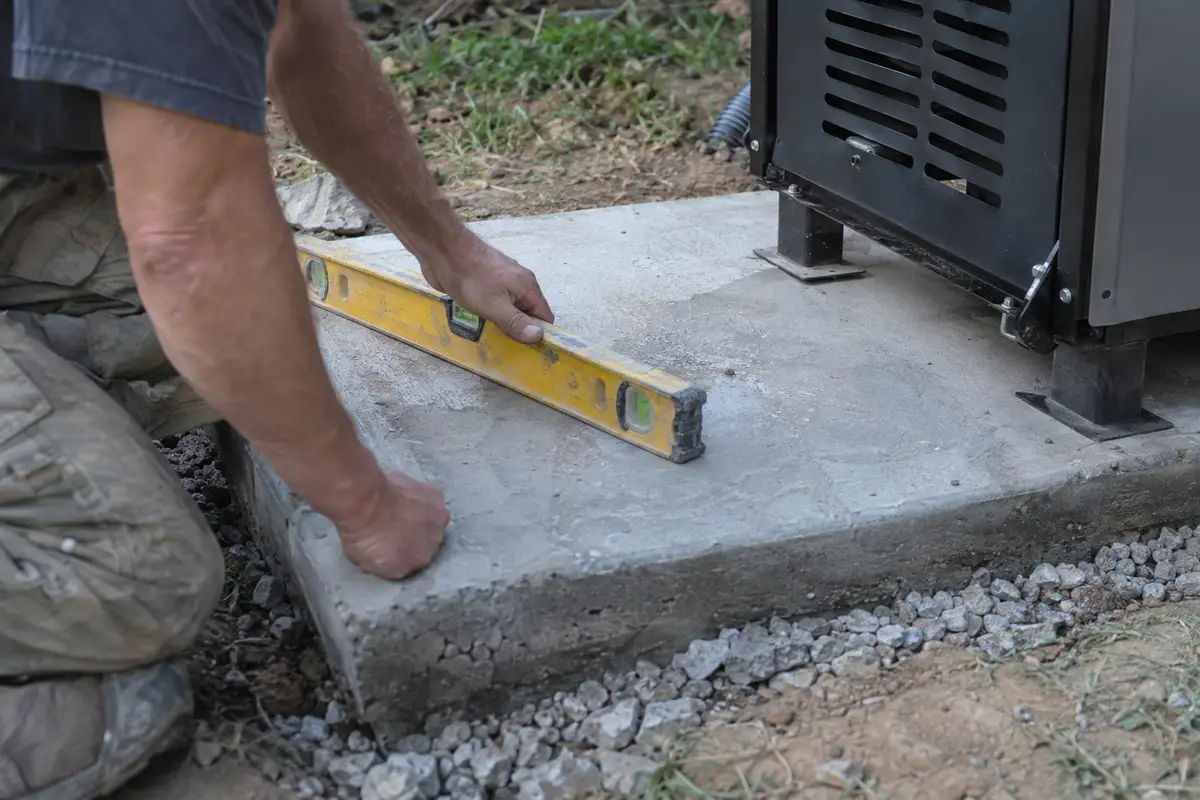
Yes, close to it. Generac requires the unit to be level within half an inch all around, so we check the base and pad with a level before anything is set on it.
Yes, when local code or the manufacturer requires it, usually with 3/8 inch lag bolts into the concrete. We can drill the holes or leave that to whoever sets the unit.
Yes, a precast pad on a compacted stone bed is doable for a handy owner. Where DIY pads go wrong is clearances and level, and either can fail the inspection.
Yes, we haul away the extra soil, sod, and form boards.
